Last updated: September 30, 2026 • 12 min read • By Mobile Car Spa Detailing Specialists
You've decided to protect your car's paint. You've done some research. And now you're stuck between two options that sound similar but work very differently: Paint Protection Film (PPF) and Ceramic Coating.
If you drive in Chennai — battling OMR construction dust, GST Road gravel, coastal humidity, and 45°C surface temperatures — choosing the wrong one could mean wasting tens of thousands of rupees on protection that doesn't address your actual driving conditions.
At Mobile Car Spa, we've inspected, detailed, and applied ceramic coatings on hundreds of vehicles across Chennai — from luxury sedans along ECR to family SUVs in Velachery and Anna Nagar. We're also actively expanding our studio paint protection film services. In this definitive guide, we give you the honest, practical breakdown of both options so you can make the right decision for your car, your driving habits, and your budget.
Quick Answer
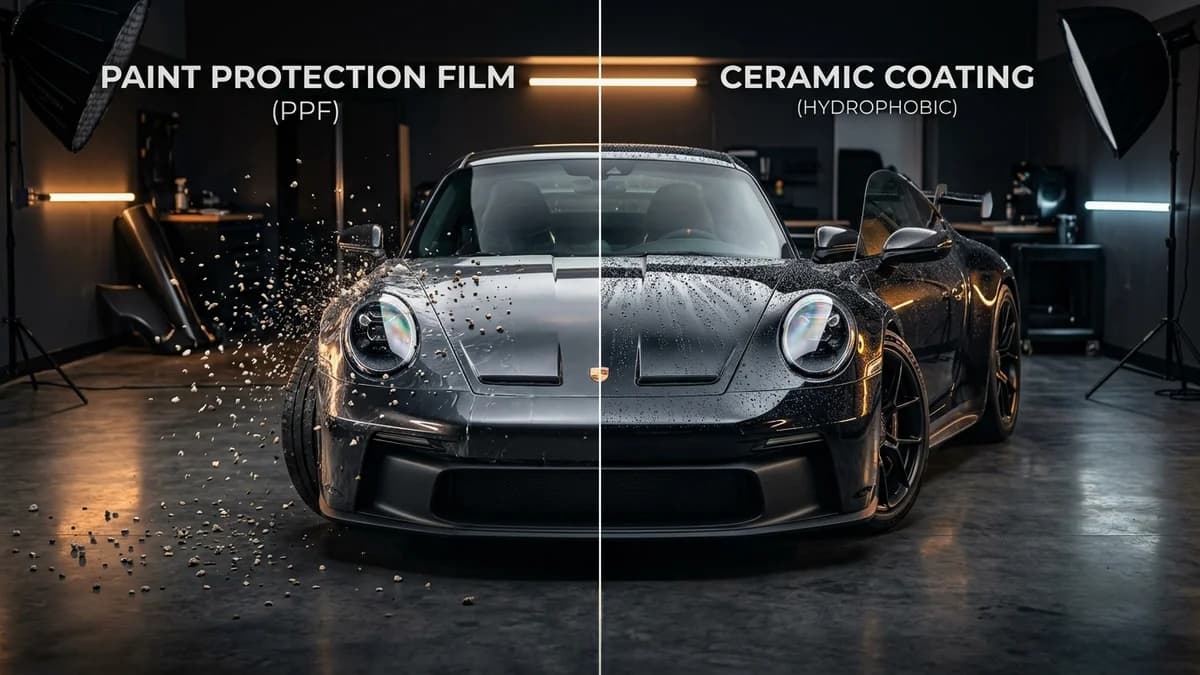
PPF and ceramic coating solve fundamentally different problems.
- PPF (Paint Protection Film) is a thick (150–200 micron) physical polyurethane film that acts as armor. It absorbs rock chips, flying gravel strikes, and parking scuffs — protecting your factory paint from physical destruction.
- Ceramic Coating is a microscopic (1–2 micron) liquid nano-ceramic polymer that bonds with your clear coat. It provides intense glass-like gloss, extreme hydrophobicity, UV resistance, and chemical protection — making your paint effortless to clean and repelling Chennai's notorious hard water spots.
Which should you choose?
- If you commute on highways (OMR, ECR, NH-48) and worry about stone chips → Paint Protection Film (PPF).
- If you commute within Chennai city, park under covers, and want showroom wet-gloss and easy weekly washes → Ceramic Coating.
- If you own a new or luxury vehicle and budget permits → Both layered together (PPF on high-impact front panels, Ceramic on the rest).
Table of Contents
- What is Paint Protection Film (PPF)?
- What is Ceramic Coating?
- The Core Difference: Physical Armor vs Chemical Enhancement
- Detailed Comparison Table
- Why Chennai Conditions Change the Equation
- Real-World Chennai Driving Scenarios
- Can You Use Both PPF and Ceramic Coating Together?
- Realistic Cost Breakdown for Chennai
- Routine Washing & Maintenance Guide
- Who Should Choose What?
- What Mobile Car Spa Recommends
- Frequently Asked Questions (FAQ)
What is Paint Protection Film (PPF)?
Paint Protection Film (PPF) is an optically clear, high-durability thermoplastic polyurethane (TPU) membrane — typically 150 to 200 microns thick — that is professionally wrapped over your vehicle's painted panels.
Think of it as an invisible impact shield sitting directly between your vehicle's factory paint and the outside world.
 High-grade TPU film absorbs the kinetic energy of flying road debris on high-speed Chennai corridors like OMR and ECR.
How PPF Works
When a flying piece of gravel strikes your bumper at 80 km/h on the ECR, the polyurethane film compresses and dissipates the kinetic energy across its surface. The film takes the blow instead of your clear coat.
Premium modern TPU films feature an elastomeric polymer topcoat with self-healing properties: minor surface swirls, light branch scratches, and wash-mitt abrasions disappear automatically when exposed to ambient warmth or sunlight — an environmental feature Chennai delivers year-round.
What PPF Protects Against
- Stone chips and gravel projectiles: High-speed strikes on highways like OMR, ECR, Chennai Bypass, and GST Road.
- Parking scuffs and door dings: Tight apartment basement parking lots in Anna Nagar, T. Nagar, and Adyar.
- Road construction sandblasting: Airborne grit around ongoing metro rail and flyover construction sites across Chennai.
- Vandalism and minor key marks: The sacrificial TPU barrier absorbs surface friction before reaching the base color coat.
- Acidic bird droppings and insect etching: Prevents biological acids from burning directly into the clear coat.
What PPF Does Not Do
- It does not provide the intense water-sheeting hydrophobicity of a ceramic coating on its own (unless topped with ceramic).
- It requires specialized, clean-room studio installation by certified technicians.
- High-grade TPU films represent a substantial financial investment compared to chemical coatings.
👉 Learn more about our Paint Protection Film services in Chennai
What is Ceramic Coating?
A professional ceramic coating is a liquid polymer formulated with Silicon Dioxide (SiO2) and Titanium Dioxide (TiO2). When applied by hand over properly prepped and polished paint, it forms a semi-permanent, covalent chemical bond with your vehicle's factory clear coat.
Once cured, it creates an ultra-dense, glass-like protective barrier measuring 1 to 2 microns thick that transforms the tactile and optical properties of your car's exterior.
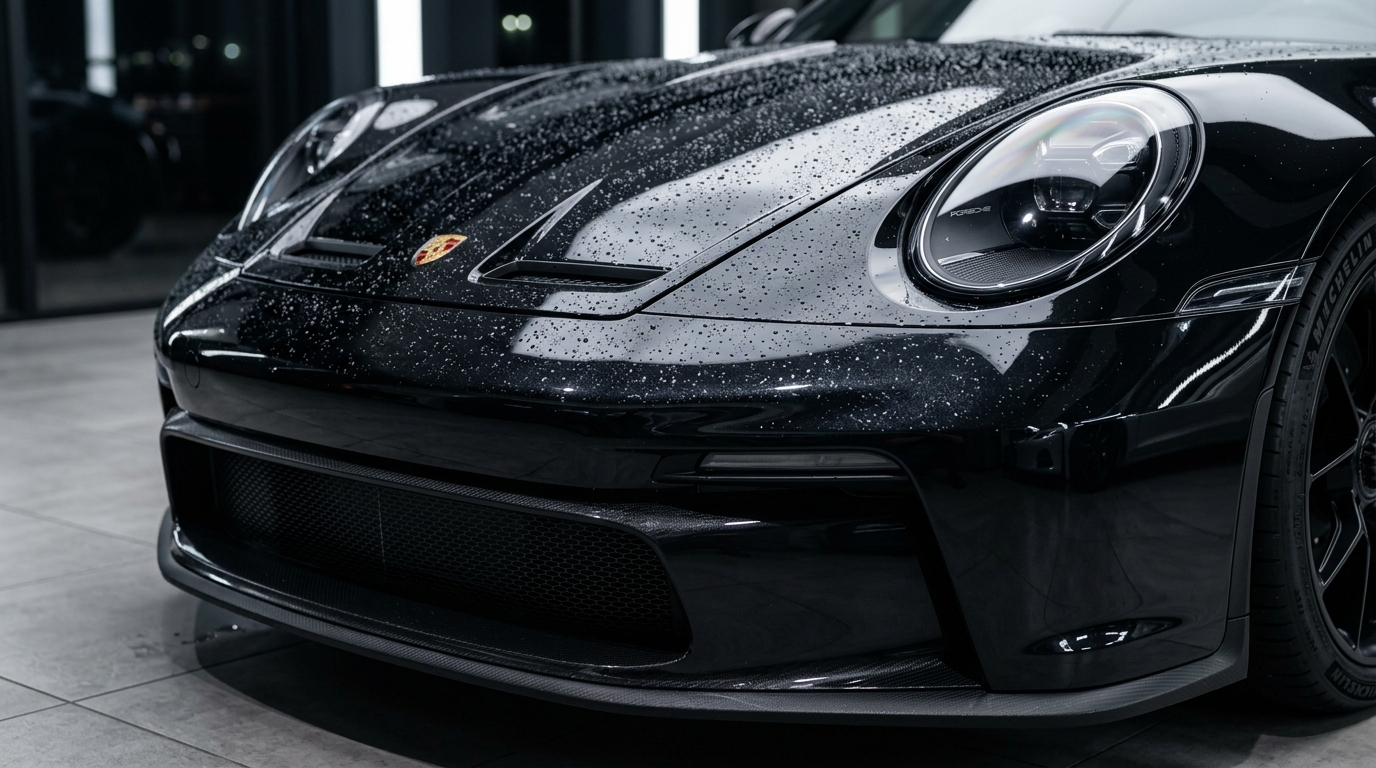
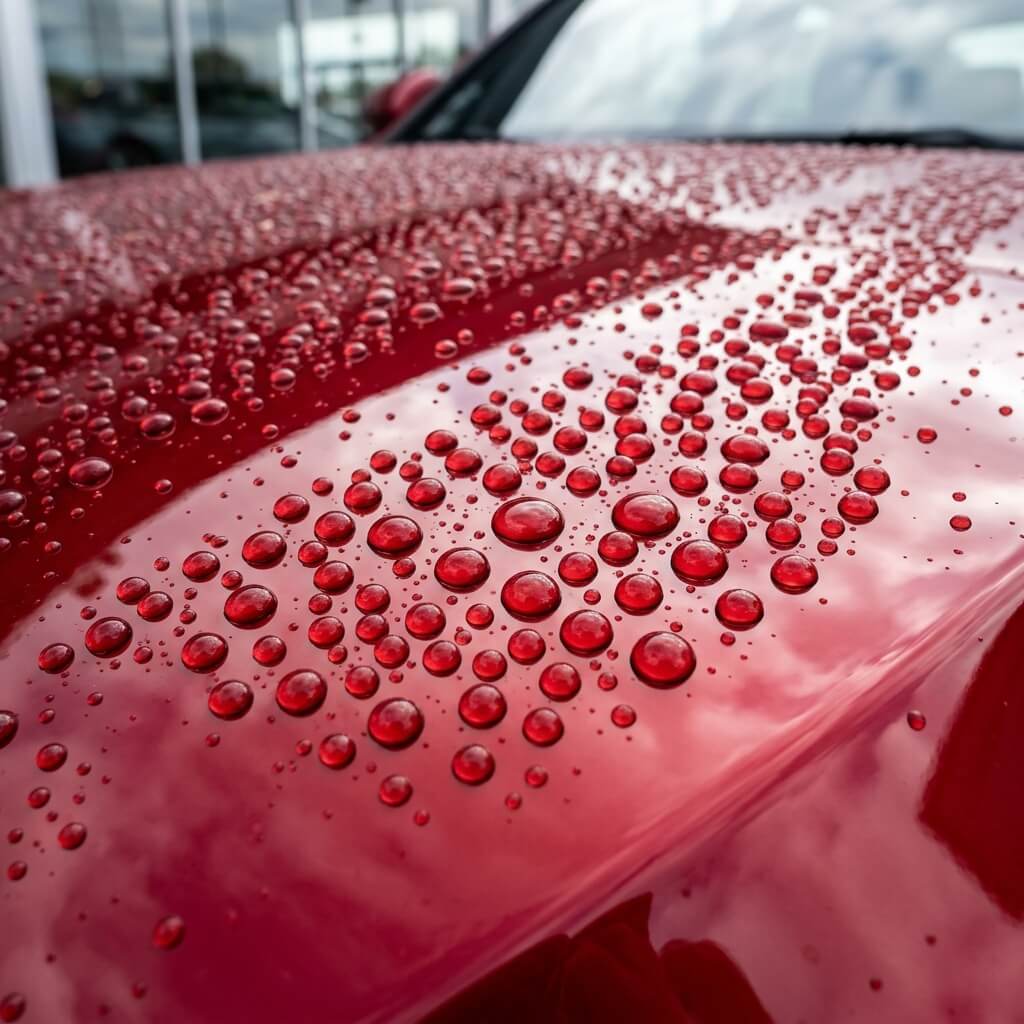 Hydrophobic ceramic coating causes water and road contaminants to bead and roll off, resisting mineral-heavy Chennai borewell water.
How Ceramic Coating Works
Unlike wax, which merely sits on top of your clear coat and melts when ambient temperatures rise above 60°C, a ceramic coating cures into the microscopic pores of your paint. This creates an ultra-smooth, hydrophobic surface with water contact angles exceeding 110°.
Water, mud, and environmental grime cannot easily grip the surface, allowing dirt to rinse away with minimal friction during your doorstep car wash in Chennai.
What Ceramic Coating Protects Against
- Extreme UV degradation and paint fading: Chennai experiences over 250 days of brutal solar radiation that oxidizes clear coats. Read how Chennai's climate damages car paint.
- Hard water mineral deposits: Borewell and municipal water in Chennai often carries TDS levels exceeding 1,000 ppm. Ceramic coating prevents minerals from bonding deeply into clear coat pores. Read our hard water spot removal guide.
- Coastal salt air corrosion: Cars parked near Marina Beach, Besant Nagar, Thiruvanmiyur, or along ECR face airborne salt fog that degrades bare paint.
- Bird droppings and tree sap etching: The chemical resistance of SiO2 resists harsh biological acids until you wipe them clean.
- Industrial fallout and exhaust soot: Heavy traffic corridors like Guindy and GST Road coat cars in microscopic industrial soot that ceramic coatings resist.
What Ceramic Coating Does Not Do
- It cannot stop rock chips: A 1–2 micron liquid layer cannot absorb the physical impact of a flying stone. Anyone promising rock-chip protection from ceramic coating is misleading you.
- It will not prevent deep key scratches: While it provides minor resistance against micro-swirls during washing, sharp physical impacts cut right through.
- It is not maintenance-free: Coated cars still require periodic washes with pH-neutral car shampoo and clean microfiber towels.
👉 Explore our Ceramic Coating packages in Chennai
The Core Difference: Physical Armor vs Chemical Enhancement
To make the right investment, remember this simple analogy:
| Comparison |
Paint Protection Film (PPF) |
Ceramic Coating |
| Core Philosophy |
"Protect the paint from taking the hit" |
"Make the paint easier to maintain and brilliant to look at" |
| Material Type |
Physical TPU elastomeric sheet (150–200 µm) |
Chemical liquid nano-silica bond (1–2 µm) |
| Smartphone Analogy |
Tempered glass screen protector |
Hydrophobic/oleophobic anti-smudge coating |
| Primary Beneficiary |
Front bumper, hood, fenders, mirrors |
Full body paint, glass, wheels, plastic trim |
PPF is armor. Ceramic coating is surface enhancement. They are not rivals fighting for the same role — they are complementary technologies addressing two distinct categories of automotive wear.
If you're already familiar with traditional detailing, our Ceramic Coating vs Wax Chennai Guide covers how ceramic coating outperforms carnauba wax. PPF takes that hierarchy a step further into physical ballistic defense.
Detailed Comparison: PPF vs Ceramic Coating
| Feature / Criterion |
PPF (Paint Protection Film) |
Ceramic Coating |
| Primary Protection |
Ballistic impacts, gravel, stone chips, scuffs |
UV oxidation, chemical stains, water spots, dullness |
| Stone Chip Resistance |
✅ Maximum — Absorbs high-speed projectile strikes |
❌ None — Cannot absorb physical impacts |
| Scratch Resistance |
✅ High — Self-healing topcoat absorbs abrasions |
⚠️ Minor — Mild resistance to wash micro-marring |
| Self-Healing Ability |
✅ Yes — Sunlight/heat heals swirl marks |
❌ No — Scratches require machine polishing |
| Visual Depth & Gloss |
⚠️ Good — Preserves natural paint reflection |
✅ Exceptional — Deep, wet, glass-like optical clarity |
| Hydrophobicity (Water Beading) |
⚠️ Moderate (Premium films feature infused coats) |
✅ Extreme (>110° water contact bead angle) |
| UV & Heat Resistance |
✅ Good (UV-stabilized modern TPU) |
✅ Superior (Withstands temperatures up to 600°C) |
| Resistance to Hard Water |
⚠️ Moderate (Requires periodic cleaning) |
✅ High (Water sheets off before drying) |
| Expected Lifespan |
5 to 10 Years (depending on TPU grade) |
1 to 5 Years (depending on formula & layers) |
| Coverage Area |
High-impact front profile or full vehicle |
Full exterior (paint, lights, wheels, trims) |
| Installation Turnaround |
2 to 5 business days |
1 to 2 business days (including paint correction) |
| Investment Level |
Premium (Material & labor intensive) |
Moderate to High (Multi-stage machine polishing included) |
Why Chennai Conditions Change the Equation
Car ownership in Chennai comes with localized environmental factors rarely seen together in other metros:
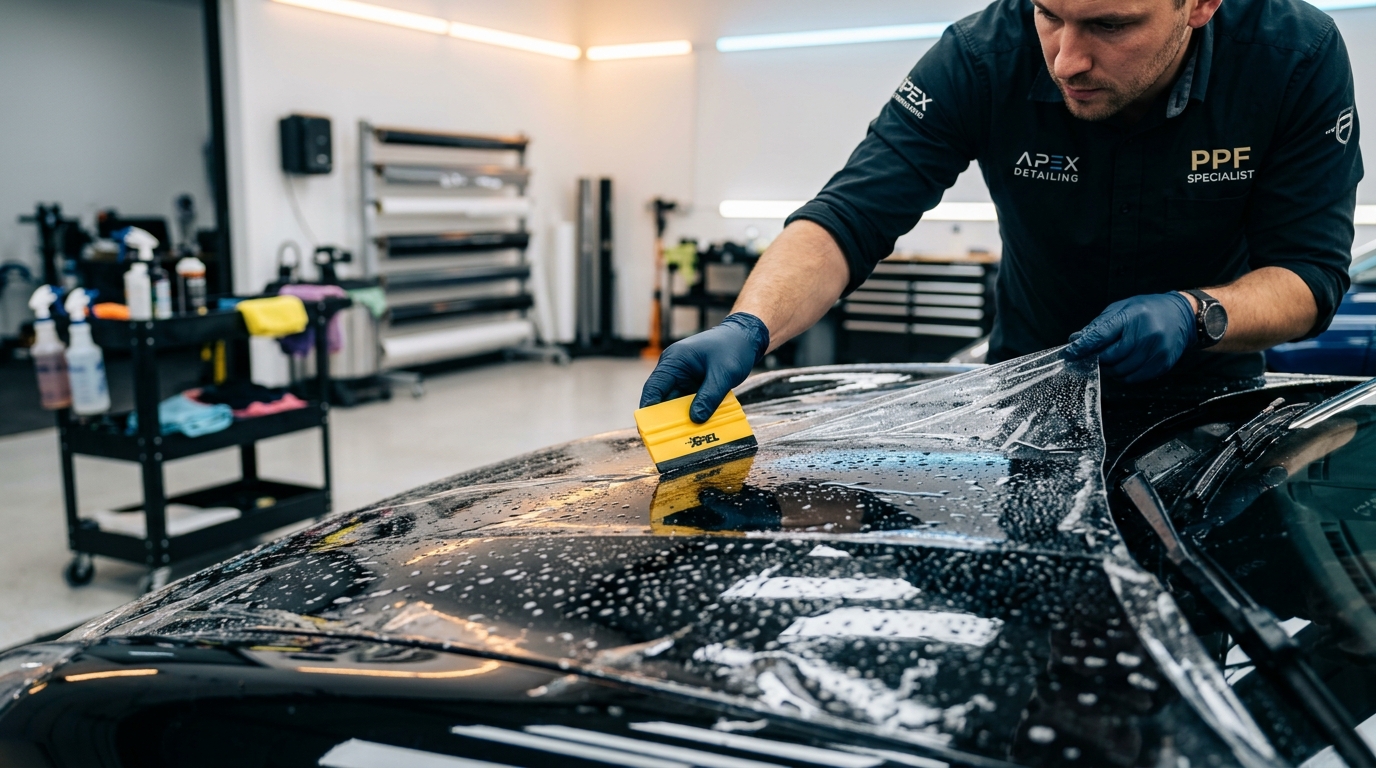 Certified detailing technicians preparing paint surfaces in a controlled environment before protection application.
1. High-Speed Gravel & Highway Construction
Chennai's major arterial routes — particularly the OMR IT corridor, ECR, and the Chennai Outer Ring Road (CORR) — witness regular high-speed traffic mixed with sand tipper trucks and construction vehicles. Flying stones from loose asphalt are the leading cause of bonnet and bumper paint chips in vehicles under two years old.
2. Intense Solar Radiation & Surface Heat
With daytime summer temperatures regularly touching 42°C, dark vehicle body panels in Chennai reach surface temperatures of 65°C to 75°C. Organic car waxes melt off within weeks. While PPF films must be premium grade to prevent yellowing under intense UV, ceramic coatings excel here because their inorganic SiO2 structure remains unaffected by solar heat.
3. Mineral-Heavy Hard Water
A substantial portion of Chennai residential communities in Velachery, Medavakkam, Perungudi, and OMR depend on borewell water with heavy calcium and magnesium content (TDS 800–1500+ ppm). When hard water evaporates on an unprotected clear coat under midday sun, it leaves etched mineral rings that cannot be washed off. Ceramic coating's hydrophobic properties minimize water retention, drastically cutting water spotting risk.
4. Coastal Salt Fog
Properties located within 5 kilometers of the Bay of Bengal (ECR, Besant Nagar, Thiruvanmiyur, Santhome) face continuous salt-laden marine air. Salt particles accelerate oxidation on any paint area that has sustained micro-chips or clear-coat failure.
Real-World Chennai Driving Scenarios
To help you decide, let's look at three typical vehicle profiles we encounter every week at Mobile Car Spa:
Scenario A: The OMR / ECR Daily Highway Commuter
- Vehicle Example: Tata Safari, Mahindra XUV700, or Hyundai Creta
- Daily Route: Commuting from Thiruvanmiyur/Adyar down OMR to Siruseri or Mahindra World City
- Primary Threat: Loose gravel tossed by trucks, high-speed debris, bugs on ECR
- The Right Choice: Front-End PPF Package + Ceramic on the rest. The front bumper, hood, fenders, headlights, and side mirrors take 85% of physical highway impacts and need TPU film armor. The remaining body panels stay protected with ceramic coating.
Scenario B: The City Executive Commuter
- Vehicle Example: Honda City, Hyundai Verna, or Kia Seltos
- Daily Route: City driving through Anna Nagar, T. Nagar, Nungambakkam, and Alwarpet; parked in corporate basements
- Primary Threat: Road grime, hard water during office washes, bird droppings under avenue trees, intense sun
- The Right Choice: Full-Body Ceramic Coating. At city speeds (20–40 km/h), rock chip risk is low. A multi-year ceramic coating delivers the deep showroom shine, UV protection, and rapid cleaning capability you need at a fraction of full PPF cost.
Scenario C: The Premium & Luxury Car Owner
- Vehicle Example: BMW 3/5 Series, Mercedes-Benz C/E-Class, Audi A4/A6, Volvo XC60
- Daily Route: Mixed city and intercity weekend drives to Pondicherry or Bangalore
- Primary Threat: Retaining factory original paint thickness and resale value
- The Right Choice: Full PPF or Track-Pack PPF topped with Ceramic. Preserving original factory paint on a luxury vehicle is paramount. Repainting panels devalues high-end cars significantly. Layering PPF with ceramic gives both ballistic defense and stunning water-beading reflections.
Can You Use Both PPF and Ceramic Coating Together?
Yes — in fact, the combination is considered the gold standard in automotive detailing.
Applying ceramic coating directly over paint protection film provides the ultimate synergy:
- The PPF serves as the mechanical shock absorber: It stops stone chips, scratches, and scrapes from touching the sheet metal.
- The Ceramic Coating serves as the surface enhancer: Modern ceramic coatings formulated specifically for TPU films add high-slip hydrophobicity, stain resistance against bird droppings and tree sap, and an intensified glossy finish that standard film cannot match alone.
The Smart Hybrid Approach (Best Value for Premium Cars)
Rather than spending ₹1.5L to ₹2.5L+ on a full vehicle PPF wrap, many smart car owners in Chennai opt for the Hybrid Protection Package:
- PPF on High-Impact Zones: Front bumper, full hood, front fenders, headlights, side mirror caps, door edges, and door handle cups.
- Ceramic Coating on All Remaining Panels: Roof, doors, rear quarter panels, trunk lid, plus a topcoat applied directly over the front PPF for seamless uniform gloss.
This hybrid approach gives you 90% of the practical real-world protection of a full wrap at roughly half the total investment.
Realistic Cost Breakdown for Chennai
While pricing varies based on vehicle segment (Hatchback vs Mid-SUV vs Full-Size Luxury) and the brand of material used, here is a transparent market benchmark for Chennai:
| Paint Protection Package |
Coverage |
Typical Chennai Price Range |
Expected Durability |
Maintenance Frequency |
| Entry Ceramic Coating |
Full exterior paint |
₹15,000 – ₹22,000 |
1 to 2 Years |
Annual inspection |
| Professional 9H/10H Ceramic |
Full exterior + wheels + glass |
₹24,000 – ₹42,000 |
3 to 5 Years |
Bi-annual check & top-up |
| Front-End PPF ("Track Pack") |
Bumper, hood, fenders, mirrors |
₹45,000 – ₹75,000 |
5 to 7 Years |
Edge inspection |
| Full-Body PPF Wrap |
All painted exterior panels |
₹1,20,000 – ₹2,20,000+ |
7 to 10 Years |
Gentle wash maintenance |
| Hybrid (Front PPF + Full Ceramic) |
High-impact PPF + 3-Yr Ceramic |
₹65,000 – ₹1,05,000 |
5 to 7 Years |
Bi-annual ceramic top-up |
⚠️ Detailing Truth from Mobile Car Spa: Beware of "too good to be true" cheap PPF offers (e.g., ₹40,000 for a full car wrap). Low-grade PVC or cheap TPH films yellow rapidly in Chennai's sunlight, peel at panel edges, and leave stubborn adhesive residue when removed that can strip your clear coat. Always ask for certified TPU film with a verifiable manufacturer warranty.
Routine Washing & Maintenance Guide in Chennai
Whichever protection you choose, improper washing can degrade your investment prematurely:
- Never allow dry wiping: Apartment watchmen or domestic cleaners using dry, dusty cloths act like sandpaper on both bare paint and protective coatings.
- Avoid borewell water with high TDS: Washing your car with raw borewell water in Chennai leaves mineral crusts. If borewell water must be used, wipe dry immediately using high-GSM microfiber towels.
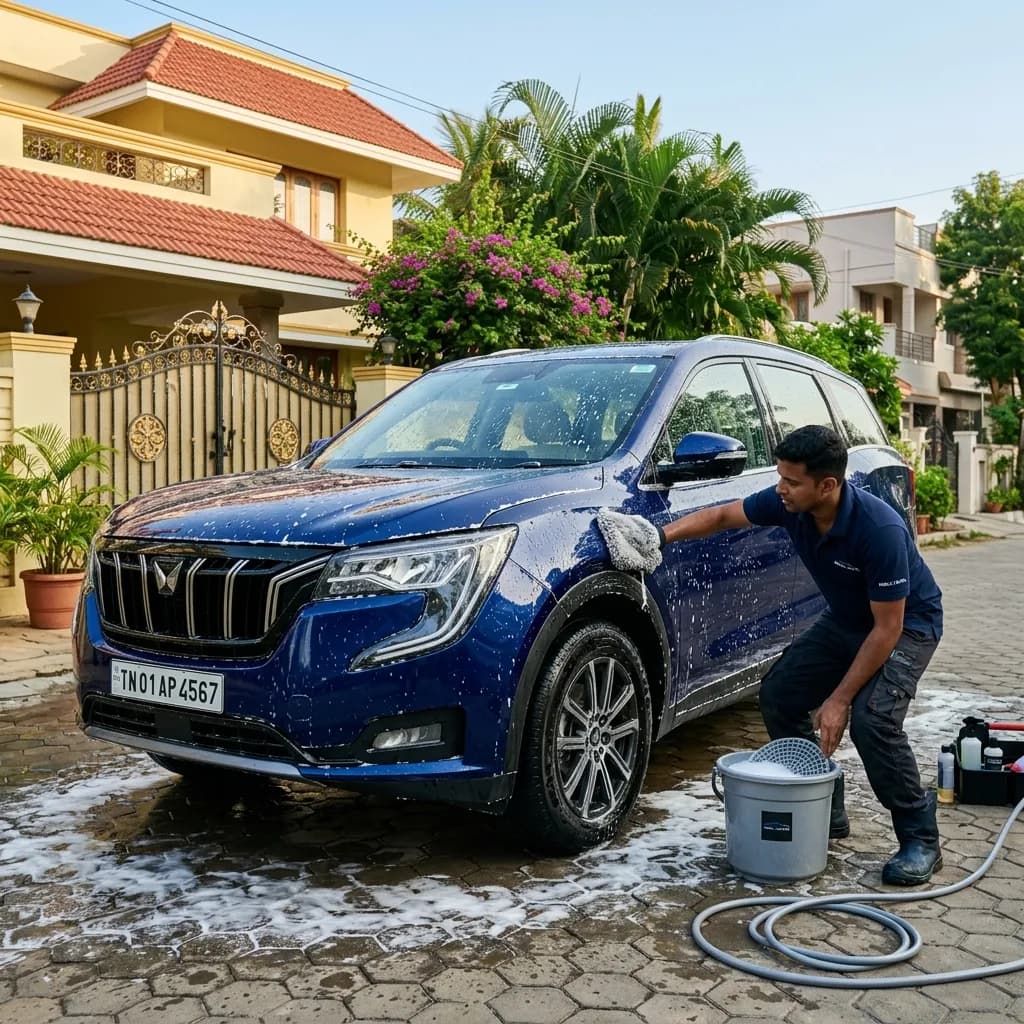
- Use the two-bucket method or contact-free foam: Separate your rinse water from shampoo water to prevent dirt grit from swirling the paint. Learn more in our guide on how often you should wash your car in Chennai.
- Choose professional doorstep washes: For safe, regular upkeep, consider scheduling a monthly or bi-weekly doorstep car wash in Chennai with Mobile Car Spa.
- Periodic Detailing Inspection: Have your paint inspected every 6 months to remove embedded iron fallout and refresh hydrophobic topcoats. Check our guide on how often you should detail your car in Chennai.
Who Should Choose What?
Choose Ceramic Coating If:
- You primarily drive within Chennai city limits (Anna Nagar, T. Nagar, Mylapore, Adyar).
- Your vehicle is parked under covered parking or apartment basements.
- You want intense showroom gloss, mirror reflections, and slick hydrophobic water beading.
- You want protection against UV fading, borewell water spots, tree sap, and bird droppings.
- You want high-level protection with an accessible budget (₹18k – ₹35k).
- 👉 View our Ceramic Coating packages in Chennai
Choose Paint Protection Film (PPF) If:
- You commute regularly at highway speeds along OMR, ECR, Chennai Bypass, or GST Road.
- You drive past active flyover and metro rail construction zones with flying grit and stones.
- You have a brand-new vehicle and want to preserve 100% factory original paint for maximum resale value.
- You frequently encounter tight parking spaces prone to bumper scuffs and careless door dings.
- Physical scratch prevention is your non-negotiable priority.
- 👉 Explore Paint Protection Film options in Chennai
Choose Both (Hybrid PPF + Ceramic) If:
- You own a premium SUV or luxury vehicle (₹25L+ category).
- You want physical impact armor on high-strike zones combined with deep wet gloss across the entire body.
- You plan to keep your vehicle for 5 to 7+ years and want total peace of mind.
What Mobile Car Spa Recommends
At Mobile Car Spa, we believe in providing honest, practical advice tailored to each customer rather than pushing the most expensive service:
- For 75% of Chennai city car owners, a multi-layer professional ceramic coating preceded by thorough multi-stage paint correction delivers the best balance of cost, UV protection, hard water resistance, and effortless maintenance.
- If you commute daily on OMR, ECR, or national highways, do not rely on ceramic coating alone for stone chips. Invest in a front-end PPF package for your bumper, hood, and mirrors, and pair it with ceramic coating for the remaining bodywork.
Our certified ceramic coating service is currently available across all Chennai neighborhoods with studio and doorstep options. We are also expanding our dedicated PPF studio operations — you can join our priority list to reserve exclusive introductory packages.
Frequently Asked Questions (FAQ)
Is PPF better than ceramic coating for cars in Chennai?
Neither is universally "better" — they solve different problems. PPF is superior for physical impact protection against stone chips, highway gravel, and parking scuffs on roads like OMR and ECR. Ceramic coating is superior for UV radiation resistance, deep glass-like gloss, hydrophobic water repellency, and resisting Chennai's mineral-heavy borewell water. The best choice depends on whether your biggest threat is physical debris (PPF) or environmental weathering (Ceramic).
Can I apply ceramic coating over Paint Protection Film (PPF)?
Yes, and it is highly recommended. Applying a ceramic coating over PPF enhances the film's hydrophobic water-beading performance, adds superior UV and stain resistance against bird droppings, and gives the film an ultra-glossy finish that makes weekly washing effortless.
Does ceramic coating prevent stone chips from flying gravel?
No. Ceramic coating is only 1 to 2 microns thick. While it hardens the surface clear coat against micro-marring and wash swirls, it cannot absorb the kinetic energy of a flying stone or gravel projectile at highway speed. For genuine stone chip prevention, you require Paint Protection Film (PPF), which is 150 to 200 microns thick.
How long does PPF last compared to ceramic coating in Chennai's climate?
High-grade TPU PPF generally lasts 5 to 10 years, depending on film quality, maintenance, and UV exposure. Professional ceramic coatings last between 1 to 5 years depending on the grade, number of layers, and wash care. Both require avoiding abrasive dry wiping and using pH-neutral car shampoos to maximize longevity.
Which is more cost-effective in Chennai: PPF or ceramic coating?
For city commuters, ceramic coating is significantly more cost-effective (₹18,000–₹35,000) because it addresses Chennai's primary everyday issues: UV fading, borewell water spots, and coastal humidity. PPF involves a higher investment (₹45,000–₹1,50,000+) but becomes highly cost-effective for highway drivers who would otherwise face costly panel repainting and substantial resale value loss from gravel pitting.
Should I get PPF or ceramic coating for a brand-new car?
A brand-new car is the ideal time for both treatments because the factory clear coat is pristine and requires minimal corrective compounding. If your budget allows, a hybrid package (PPF on front bumper, hood, and mirrors, with ceramic coating on all remaining panels) provides the most comprehensive new car protection in Chennai.
Can PPF turn yellow over time in Chennai's intense summer heat?
Low-quality PVC or TPH films will oxidize and turn yellow within 12–18 months under Chennai's intense UV radiation. However, high-grade thermoplastic polyurethane (TPU) films feature UV-stabilized adhesives and non-yellowing topcoats backed by 5 to 10-year manufacturer warranties. Mobile Car Spa only recommends certified TPU films.
How should I wash my car after getting PPF or Ceramic Coating?
Avoid commercial automated brush car washes and never allow dry wiping with dusty cloths. Wash your vehicle using touchless foam or the two-bucket method with a pH-neutral car shampoo and clean microfiber mitts. For PPF, avoid pointing high-pressure spray lances closer than 12 inches to panel edges. For convenient upkeep, Mobile Car Spa provides specialized doorstep maintenance washes across Chennai.
Ready to Protect Your Car's Paint in Chennai?
Whether you're leaning toward the glass-like shine of ceramic coating or the rock-solid armor of paint protection film, Mobile Car Spa is here to help you make the right choice: